





 ABOUT US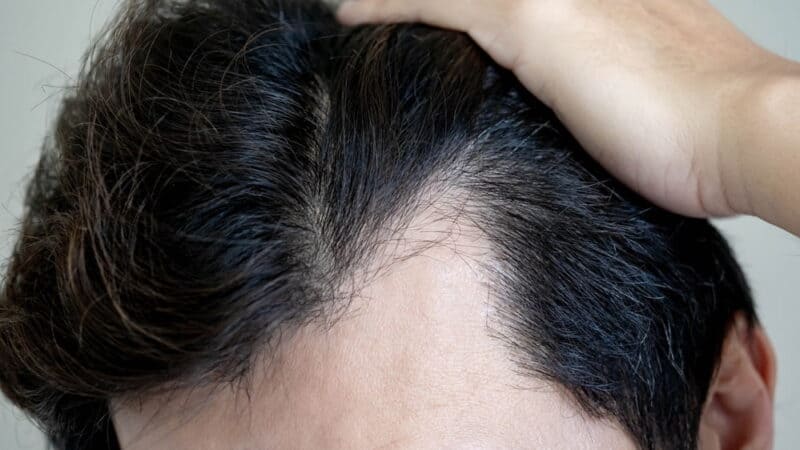
Temporal Point Hair Restoration: Techniques, Design, and Key Considerations
Learn what temporal point hair restoration is, what risks and graft needs to consider, and when to consult the hair experts at Bangkok Hair Clinic.
Learn what temporal point hair restoration is, what risks and graft needs to consider, and when to consult the hair experts at Bangkok Hair Clinic.

|
|
|
Author |
|
|
Profile |
A specialist in DHI (Direct Hair Implantation) hair transplant techniques, graduated from the University of Birmingham. He learned advanced hair transplantation techniques under the guidance of Dr. Tayfun Oguzoglu, a globally renowned hair transplant expert. Trusted by numerous patients, Dr. Jirayu has established a reputation for excellence in the field of hair restoration. |
|
Date |
July 7, 2026 |
|
Share |


|
When patients think about hair restoration, they usually focus on the frontal hairline. That matters, but it is not the whole frame. The temporal points, the angled front corners of the side hairline near the temples, help connect the frontal hairline to the side of the scalp. If the frontal hairline is restored but the temple area is left too open, the result can still look incomplete. Hair restoration references and ISHRS educational material both describe temple-point work as a high-skill area that requires careful planning.
Temporal points are the front outer corners of the lateral hairline. They shape the transition between the frontal hairline and the temple region, and they affect how wide, recessed, or balanced the upper face appears. In practical terms, they are small structures with a big visual role.
Temporal point hair restoration can improve facial framing and make a hairline look more natural. Even a strong central hairline may not look finished if temple recession remains severe. This is especially relevant in patients with frontotemporal recession, asymmetric temple loss, or prior hair transplant work that focused only on the frontal edge.
Patients with temple recession from androgenetic hair loss, naturally weak or asymmetric temporal points, or those lacking facial framing after a previous frontal transplant may benefit from this procedure. Current hair transplantation guidance stresses the importance of donor supply, scalp condition, and hair-loss stability before surgery is planned. While temporal point restoration can address stable scarring, it is most commonly used to treat recession; however, not every patient is a candidate due to donor constraints.
The procedure of restoring temporal points with hair transplant is usually performed with FUE principles. However, while the occipital area (back of the head) is the primary donor for general transplants, for temporal points, surgeons often prefer the parietal scalp (above the ears). After consultation and design, grafts are harvested, refined, and placed into the temple area. What makes this area different is the angle and direction. Hairs around the temple must sit very flat to the skin, often requiring sub-10 degree angles (almost parallel to the skin) to avoid a “hedgehog” effect. While frontal hairs are implanted at very acute angles, often around 10 to 20 degrees, temporal hair naturally lies flatter than any other area on the scalp. If the angle is wrong, the result can look unnatural quickly.
Among all the steps in restoring temporal points with hair transplants, design is one of the most important factors. The surgeon must consider the patient’s facial proportions, age, natural asymmetry, ethnicity, current hair characteristics, and future hair loss. Given the potential for receding native hair, conservative planning is particularly vital because an aggressive temple design might not age gracefully.
Graft choice matters too. The temple area usually needs finer grafts and soft transitions. ISHRS (International Society of Hair Restoration Surgery) material recommends one- and two-hair grafts in this area, 200 – 400 grafts per side (depending on recession), not bulky graft groupings. Density also has to stay realistic. Temple restoration usually has 20–30 grafts per square centimeter and is not usually packed like the central forelock. It is built to look natural at conversational distance, not overly dense up close.
There is no single graft number that fits every case. The answer depends on how recessed the area is, whether one or both sides need correction, the target density, and donor availability. In practice, some patients need only modest refinement, while others need broader bilateral work. The temple region is small, but it still requires careful donor use because every graft matters.
The benefits of temporal point restoration include better facial framing, a more complete-looking hairline, and improved balance between the frontal hairline and the sides. In certain cases, it can enhance the outcome of a previous hair transplant that was too dense at the front.
The risks are mostly related to design and placement. If the angle, direction, or density is wrong, temple work can look artificial. General transplant risks such as shock loss, scarring, graft failure, and poor growth also apply. This is why temple restoration should be done conservatively and by a surgeon with strong experience in natural hairline design.
Recovery is similar to that of other small-area FUE procedures. Patients can expect short-term redness, scabbing, and temporary shedding before new growth begins. Final maturation takes time, and the result should not be judged too early.
Temporal point hair restoration may involve a relatively small area, but it has a major effect on how natural, balanced, and complete the hairline looks. Because this zone requires careful planning, precise graft placement, and a strong understanding of facial proportions, it is not a procedure that should be approached casually.
Proper design choices can better frame the face and establish a natural flow from the front hairline to the sides. Conversely, insufficient planning may result in awkward angles, suboptimal graft utilization, or outcomes that appear poor over time with continued hair loss. Consulting with specialists is essential for this reason.
At Bangkok Hair Clinic, our team understands that temporal point restoration is not just about filling in a recessed area. It requires a full assessment of your donor hair, scalp condition, current hair-loss pattern, facial structure, and long-term goals. Our specialists focus on natural-looking results and careful surgical planning, so patients receive treatment that suits both their immediate concerns and their future hair loss pattern. If you are considering temporal point hair restoration or other procedures, such as DHI non-shaven cost and process, meeting with our specialists is the best way to determine whether this procedure is right for you and make a personalized plan.
References:
What are temporal points in hair transplant surgery?
They are the front outer corners of the lateral hairline near the temples. They help connect the frontal hairline to the side of the scalp and strongly affect facial framing.
Is temporal point in hair transplant the same as frontal hairline restoration?
No. The frontal hairline focuses on the front edge. Temporal restoration focuses on the side corners and requires flatter angles and softer graft transitions.
If I’m getting a temporal point hair transplant, how many grafts are needed?
It varies based on the degree of recession, whether one or both sides are treated, and donor availability. A consultation is needed for accurate planning.
Is temporal point hair restoration permanent?
Transplanted donor hairs usually retain donor characteristics, but surrounding native hair may continue to thin over time, so long-term planning matters.


