





 ABOUT US
Alopecia Areata in Older Adults: Diagnosis and Care
Alopecia areata in older adults can be mistaken for normal aging. Learn how to tell the difference, what treatments work, and when to see a specialist.
Alopecia areata in older adults can be mistaken for normal aging. Learn how to tell the difference, what treatments work, and when to see a specialist.

|
|
|
Author |
|
|
Profile |
A specialist in DHI (Direct Hair Implantation) hair transplant techniques, graduated from the University of Birmingham. He learned advanced hair transplantation techniques under the guidance of Dr. Tayfun Oguzoglu, a globally renowned hair transplant expert. Trusted by numerous patients, Dr. Jirayu has established a reputation for excellence in the field of hair restoration. |
|
Date |
August 24, 2026 |
|
Share |


|
Key Takeaways
• Alopecia areata is an autoimmune, non-scarring condition that can appear at any age, though the mean age of onset is in the early to mid-thirties.
• Childhood diagnosis and extensive early involvement are linked with a less favorable long-term prognosis, while later onset generally does not carry the same risk factors.
• Diagnosing alopecia areata in older patients requires ruling out androgenetic alopecia and age-related thinning, which can look similar or overlap.
• Active alopecia areata is not treated with a hair transplant; surgical restoration is only considered once patches have been stable and inactive for a sustained period.
Patchy hair loss can be alarming at any age, but when it appears in someone over 50, the cause is not always obvious. Alopecia areata in older adults is an autoimmune condition that can easily be mistaken for normal aging or other types of hair loss, and getting the distinction right matters because each requires a different approach.
Alopecia areata is a non-scarring autoimmune condition causing hair loss. The immune system wrongly targets hair follicles, halting hair production. Sudden, irregular hair loss, typically on the scalp but also possible on the beard, eyebrows, and eyelashes, is the outcome.
The condition affects roughly 1 to 2% of the population at some point in their life. The average age of onset is around 32 for men and 36 for women, and it affects both sexes equally. While it can develop in children and adults alike, alopecia areata in the elderly is less commonly discussed. It does occur, and it can look different from cases that begin earlier in life.
Several factors are linked with a less favorable long-term course: a diagnosis in childhood, hair loss that follows a band-shaped pattern along the sides and back of the scalp, extensive involvement, disease lasting longer than one year, nail changes, a family history of the condition, and a personal history of allergic conditions such as eczema. Factors common in younger alopecia areata patients are often absent in older first-time sufferers.
Around 10% of patients with patchy alopecia areata go on to lose all their scalp or body hair. The likelihood of this is tied to those same risk factors, which tend to be concentrated in earlier-onset cases.
Alopecia areata is associated with several other health conditions, including:
• Thyroid disease
• Vitiligo
• Lupus
• Psoriasis
• Eczema
In older patients, some of these conditions may already be present or developing, which makes a broader health check an important part of the assessment. A specialist evaluating alopecia areata in older adults will typically consider whether any of these related conditions need attention alongside the hair loss.
The lifetime risk of developing alopecia areata is estimated at roughly 2%. With the average age of onset in the early to mid-thirties, first episodes in patients over 50 represent a smaller share of overall cases.
That said, the condition is likely under-recognized in this age group. Hair thinning in older adults is frequently attributed to other causes without further investigation, which means alopecia areata in older adults can go undiagnosed, particularly when patches are small or overlap with general thinning.
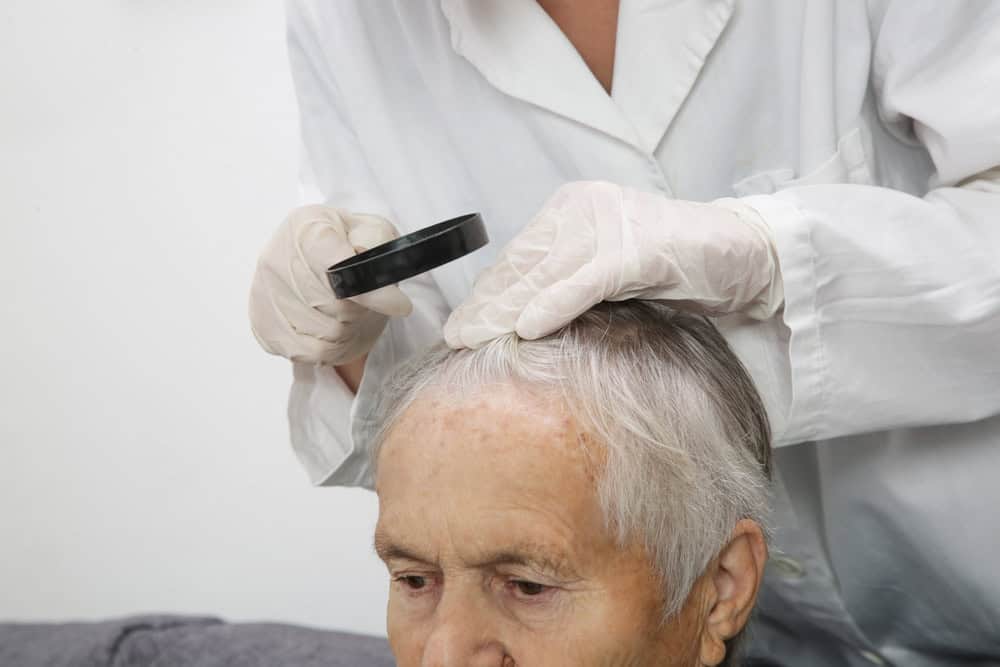
A proper examination is essential for separating alopecia areata from other causes of hair loss. Key features a specialist looks for include:
• Well-defined round or oval patches of complete hair loss, versus the gradual, widespread thinning seen in pattern baldness
• Characteristic signs visible under a dermoscope, such as exclamation-mark hairs (strands that are narrower at the base than the tip), black dots, and fine short hairs regrowing in affected areas
• A scalp biopsy in unusual cases, particularly where scarring may be involved
Alopecia areata is associated with thyroid disease and other conditions, so blood tests are also often part of the workup.
Treatment for older adults balances effectiveness against overall health risk, since many patients in this age group already manage other conditions.
• Topical and injection-based treatments: Steroid creams or steroid injections directly into the affected patches are frequently the first approach and stimulate regrowth in roughly 60 to 67% of patients.
• Oral medications: Stronger immune-suppressing medications are available but carry higher risks, including infection and cardiovascular concerns, so they are used more cautiously in older patients.
• Waiting and monitoring: Approximately 50% of patients with patchy alopecia areata experience regrowth within one year without any treatment.
A comprehensive treatment strategy is required for older folk experiencing hair thinning, as multiple contributing factors are often present simultaneously.
Transplanting hair into active or unstable alopecia areata patches carries a significant risk: the immune system may attack the newly transplanted grafts the same way it targeted the original hair. For this reason, surgery is not recommended while the condition is active.
A DHI hair transplant may be considered once the condition has been stable and inactive for a sustained period, particularly where hair loss has left a visible gap. It is also an option for older adults whose primary hair loss is pattern baldness rather than autoimmune. For patients who prefer minimal shaving and a more discreet recovery, a non-shaven approach is available and is often well suited to this age group.
At Bangkok Hair Clinic, our specialists take a comprehensive approach to managing hair loss in older patients. A thorough consultation covers your scalp condition, hair-loss stability, and overall health history before recommending any intervention. Our team creates a personalized treatment plan, whether you require medical management for active autoimmune hair loss or are contemplating surgical restoration for stable thinning, tailored to your objectives.
Book a consultation with Bangkok Hair Clinic today for an accurate assessment and a plan matched to your specific situation.
References:
Alopecia Areata. Retrieved 5 August 2026, from https://www.ncbi.nlm.nih.gov/books/NBK537000/
Hair Loss Types: Alopecia Areata Causes. Retrieved 5 August 2026, from https://www.aad.org/public/diseases/hair-loss/types/alopecia/causes
Alopecia Areata. Retrieved 5 August 2026, from https://medlineplus.gov/ency/article/001450.htm
Q: Can alopecia areata start for the first time in older age?
A: Yes. While the mean age of onset is in the early to mid-thirties, alopecia areata can occur at any age. First episodes in older adults are less common but do happen and may present differently from childhood-onset cases.
Q: How is alopecia areata diagnosed in older patients?
A: Diagnosis relies on clinical examination, looking for well-defined round or oval patches of hair loss. Dermoscopy can reveal characteristic findings such as exclamation-mark hairs. A biopsy may be needed in atypical cases, and bloodwork for thyroid and autoimmune markers is often included.
Q: Can you get a hair transplant if you have alopecia areata?
A: Not during active disease. Transplanting hair into active patches risks the immune system attacking the new grafts. A hair transplant may be considered only once the condition has been stable and inactive for a sustained period, and the treating physician has confirmed that stability.
Q: Does alopecia areata go away on its own?
A: It can. Approximately 34 to 50% of patients with patchy alopecia areata experience spontaneous regrowth within one year. However, the condition is chronic and most patients will experience recurrence at some point.


